
Assyrian Hebrew Script research
- cipherchanok
- Dec 22, 2020
- 3 min read


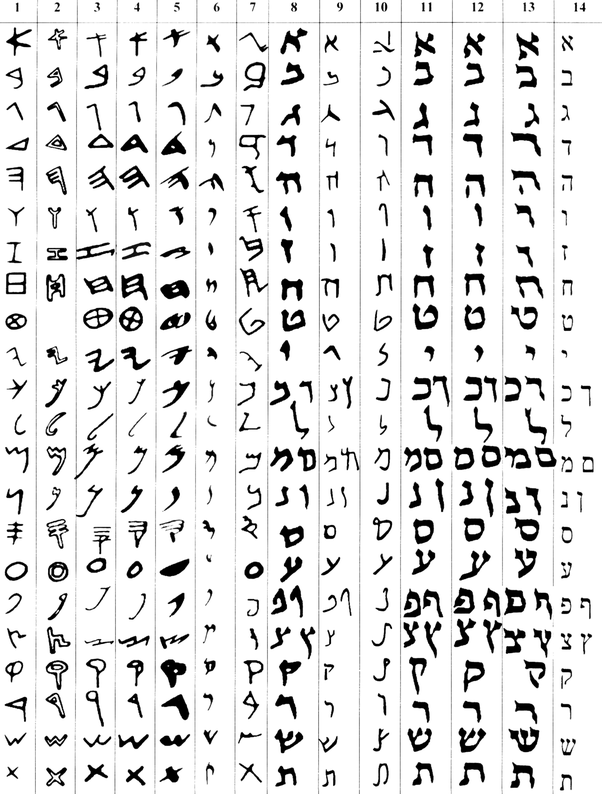


Sharing of list of info in my study of Torah why I use the Assyrian Hebrew script now called "Modern Hebrew".
Educational video discussing our ancient Shemitic language and some basic language rules. by Yisrael's Redemption
Tosefta Sanhedrin 4.7-8; Babli 21b-22a; Yerushalmi Megillah 1, 21b-21c. Comp. Also Sifre D., 160; Midrash Tannaim 145, as well as vol. IV, pp. 354 and 357. a thorough discussion of these and similar passages of the rabbinical literature, bearing upon the ‘changing of the script’ by Ezra, is given by Blau, Zur Einleitung in die Heilige Schrift, 48, seq. Besides the view given in the text, there are two others. According to one, the Assyrian characters (I. e., the square characters) were used by Moses in writing the Torah; but in course of time they were discarded by the Jews, and Ezra re-introduced them again; the other view maintains that “just as the Torah was not changed, even so is the script in which it was written unchanged”: the characters used at present came down from Moses, and were in continuous use by the Jews. Owing to the fact that the square writing was introduced in the time of Ezra, none of Belshazzar’s wise men was able to read the writing on the wall which was in the new Aramaic (1. e., square) letters. See Tosefta, loc. Cit., where אותו היום is very likely not to be taken literally. As Ezra is the author of the script used for writing the Torah, he was the one to introduce the dots over a number of biblical words, the genuineness of which was dubious. Ezra said: When Elijah comes (comp. Vol. IV,p. 233) and asks me: “Why didst thou write these spurious words”, I will answer: “Did I not place dots over them, to indicate that they are to be cancelled?” Should he, on the other hand, say: “Thou didst well in writing these words”, I shall remove the dots. See BaR 3:13; ARN 34, 101 (second version 37, 98). On the dotted words see Blau, Masoretische Untersuchungen, 6-40. In the tannaitic literature numerous references are found to ספר עזרא, the Book of Ezra, I. e., the copy of the Torah written by Ezra. The correct reading, however seems to be סי עזרה or rather סי העזרה "the copy of the Bible kept in the sanctuary.” But even if the reading עזרא is correct, it might be explained as the Aramaic form of (עזרה), comp. Kelim 15.6; Tosefta Kelim, Baba Mezi’a
5.8; Yerushalmi Shekalim 2, 47a; Mo’ed Katan 3.4 The alleged writing of Maimonides on the “Codex Ezra”, given by Di Rossi Meor ‘Enayim, 9, 150-151, bears the mark of forgery. On the other legends concerning this codex, see Sambari, 118-119, and Gelilot Erez Isreal, 99b.
Legend of the Jews Volume VI, Note 44, Page 443-444
Torah established on new moon of third month סיון (sivan), May-Jun. Torah consisted of 3 parts Pentateuch, Prophets, and Hagiographa; Oral Law, Midrash, Halakah, and Haggadah. Everything connected closely with ישראל |YaShaRa aLa is triple in number. ~Pg 79 Legend of the Jews Vol III.
before vowels pale- word-forming element used in scientific combinations (mostly since c. 1870) meaning "ancient, early, prehistoric, primitive, fossil," from Latinized form of Greek palaios "old, ancient," from palai "long ago, far back" (from PIE root *kwel- (2) "far" in space or time).
Hebrew (adj.)late Old English, from Old French Ebreu, from Latin Hebraeus, from Greek Hebraios, from Aramaic (Semitic) 'ebhrai, corresponding to Hebrew 'ibhri "an Israelite." Traditionally from an ancestral name Eber, but probably literally "one from the other side," perhaps in reference to the River Euphrates, or perhaps simply signifying "immigrant;" from 'ebher "region on the other or opposite side." The initial H- was restored in English from 16c. As a noun from c. 1200, "the Hebrew language;" late 14c. in reference to persons, originally "a biblical Jew, Israelite."
NOTE: Legend of the Jews is a **massive collation of the Haggada**--the traditions which have grown up surrounding the Biblical narrative. These stories and bits of layered detail are scattered throughout the Talmud and the Midrash, and other sources, including oral. In the 19th century Ginzberg undertook the task of arranging the Haggada into chronological order, and this series of volumes was the result.


Comments